High-Strength Plate
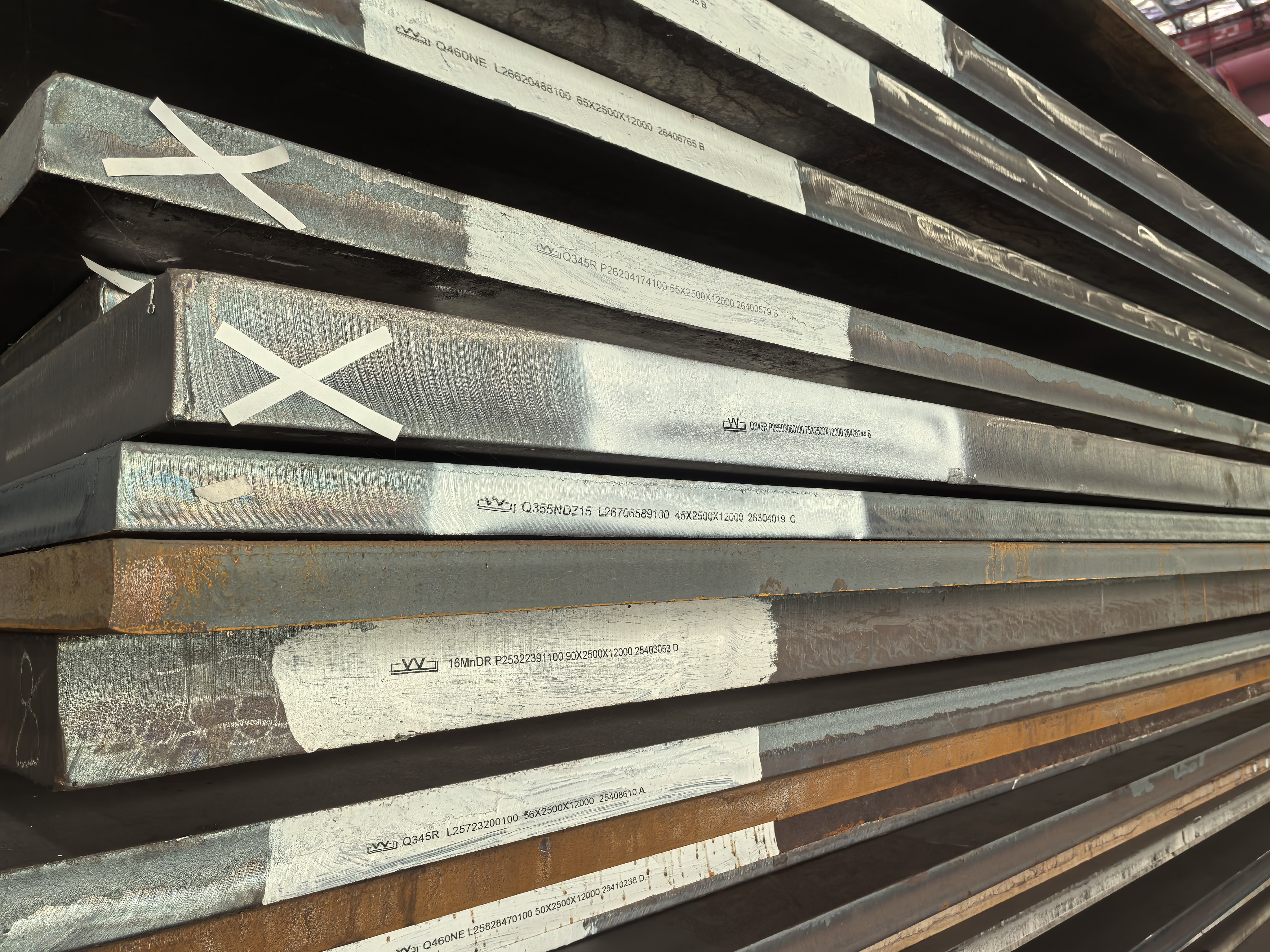
Machines keep getting lighter and booms keep reaching further — high-strength steel is why. From Q460 to Q960, the number is yield strength in MPa: Q690D yields at 690 MPa. More strength means thinner sections, lower machine mass, more payload and reach. Most of these grades are quenched and tempered, so welding procedure matters as much as the steel.
| Grade | Thickness mm | Standard | Delivery condition |
|---|---|---|---|
| Q460C / D / E | 8–150 | GB/T16270 | Q+T / TMCP |
| Q550D | 8–120 | GB/T16270 | Q+T |
| Q690D / E | 8–110 | GB/T16270 | Q+T |
| Q800D | 8–80 | GB/T16270 | Q+T |
| Q890D | 8–80 | GB/T16270 | Q+T |
| WQ590D / WQ690D | 8–120 | Wuyang mill spec | Q+T |
| WQ700D–WQ960D | 8–80 | Wuyang mill spec | Q+T |
Typical applications
Ordering notes
Beyond grade and size, watch three items: quality class (C/D/E for 0/-20/-40°C impact), carbon-equivalent ceiling, and Z direction. CEV drives preheat; boom structures often require CEV ≤ 0.50 with the formula stated per GB/T1591 or GB/T16270.
Welding practice: low-hydrogen consumables, 100–150°C preheat depending on thickness and CEV, controlled heat input to keep the softened zone narrow, and restraint with flame correction — local overheating damages Q+T properties. Wuyang WQ grades have a long service record in boom and track-beam structures.
常见问答
Which standard covers Q690D?
Quenched and tempered high-strength structural plate follows GB/T16270 as Q690D/E. OEM booms may call Wuyang's WQ690D mill specification; follow the drawing's stated standard rather than substituting.
Is preheat mandatory?
In most practical cases, yes. Above ~20 mm or with higher CEV, preheat 100–150°C with interpass control and low-hydrogen consumables; follow the qualified WPS rather than shortcutting preheat.
What do C, D, E classes mean?
Impact test temperature: C at 0°C, D at -20°C, E at -40°C. Machines working outdoors in northern winters should start at D; cold regions take E to avoid brittle fracture.
Further reading
A few related pieces worth a look: