Low-Alloy Structural Plate
If vessel plate is the specialist, low-alloy plate is the main army. Q345B — now Q355B under GB/T1591-2018 — carries the bulk of everyday tonnage: structural frames, bridges, machine bases, vehicle beams. The 2018 revision renamed Q345 to Q355 with minor composition tweaks and continuous properties, so a drawing marked Q345B is today sourced as Q355B.
| Grade | Thickness mm | Impact temp. | Standard |
|---|---|---|---|
| Q345B (now Q355B) | 6–350 | +20°C | GB/T1591 |
| Q345C / Q355C | 8–300 | 0°C | GB/T1591 |
| Q345D / Q355D | 8–300 | -20°C | GB/T1591 |
| Q345E / Q355E | 12–280 | -40°C | GB/T1591 |
| Q390B / C / D / E | 6–250 | +20°C to -40°C | GB/T1591 |
| Q420C / D / E | 8–180 | 0°C to -40°C | GB/T1591 |
| Q460C / D / E | 8–150 | 0°C to -40°C | GB/T1591 |
Typical applications
Ordering notes
The ordering levers here are quality class and UT: B through E correspond to +20 down to -40°C impact, outdoor structures through winter start at D, and structural projects often require UT per GB/T2970 to a stated class — put the class in the contract.
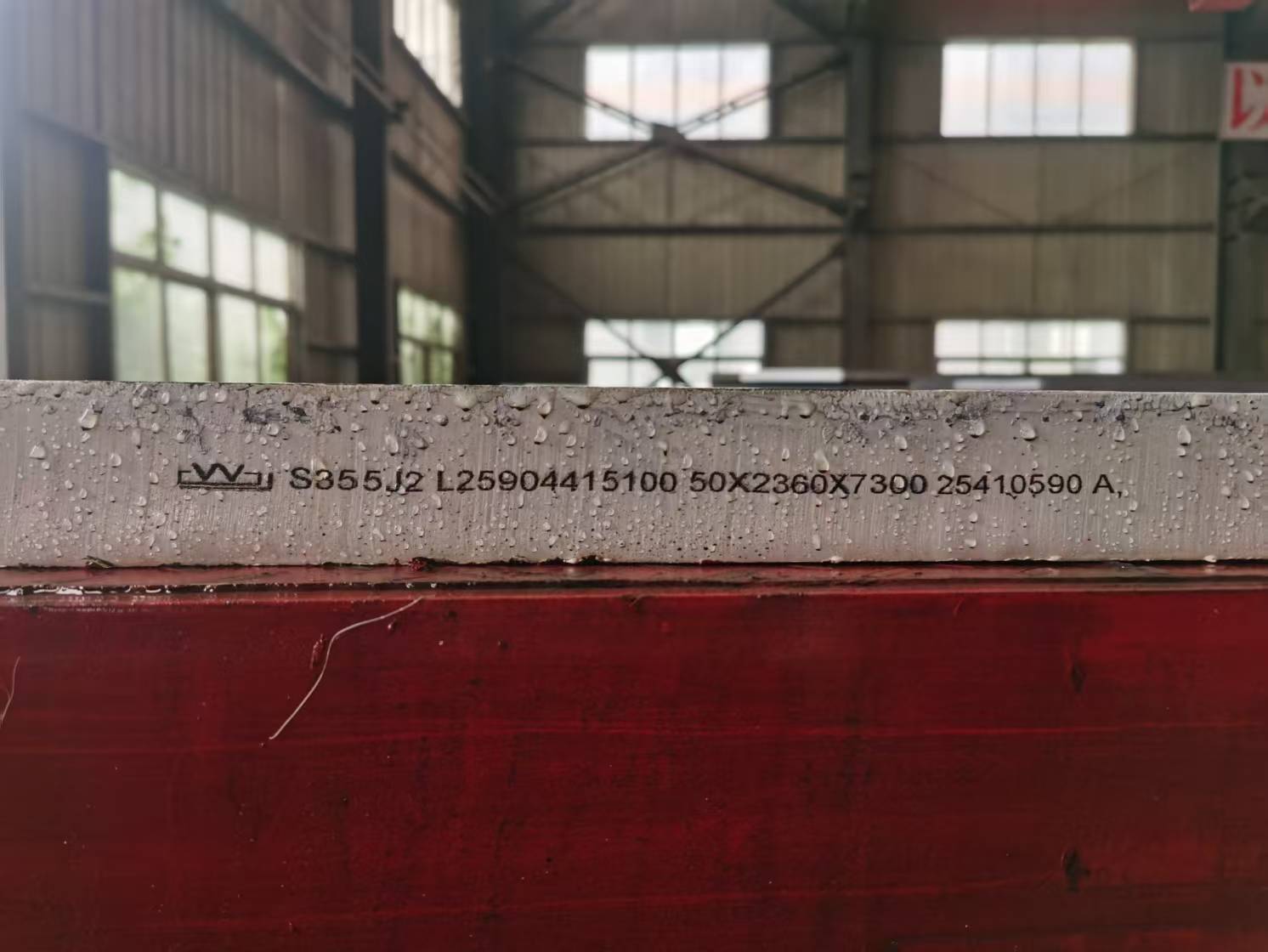
In stock: Q355B 6–100 mm, widths 1500–3200 mm, same-day loading for common sizes; oversized and Z-grade material books forward from Angang, Xingang and Nangang. Export orders can take European equivalents S355J2/J0, S275JR with EN10204 3.1 certificates.
常见问答
How do Q345B and Q355B relate?
GB/T1591-2018 renamed Q345 to Q355 with a slightly adjusted carbon ceiling and marginally higher strength. Both names circulate; when the market says Q345B today it means Q355B.
What separates B, C, D, E?
Impact test temperature: B +20°C, C 0°C, D -20°C, E -40°C. Indoor structures use B/C; loaded outdoor and low-temperature structures take D and above, at a rising price.
Any foreign equivalents?
Common pairings: Q355B≈S355JR, Q355C≈S355J0, Q355D≈S355J2; A572 Gr.50 is the usual American reference. Treat them as selection guidance — governed designs decide formally.
Further reading
A few related pieces worth a look: