Low-Temperature Vessel Plate
Once the medium drops below freezing, ordinary vessel plate loses the toughness the job needs. Low-temperature steels take a direct approach: cut carbon, add nickel, refine grain — so the plate keeps its impact energy in deep-cold service. In GB/T3531 the D stands for low temperature, and every grade answers to a defined temperature band.
| Grade | Thickness mm | Min. impact temp. | Delivery condition |
|---|---|---|---|
| 16MnDR | 6–120 | -40°C | Normalized |
| 15MnNiDR | 6–60 | -45°C | Normalized |
| 15MnNiNbDR | 10–60 | -50°C | Normalized |
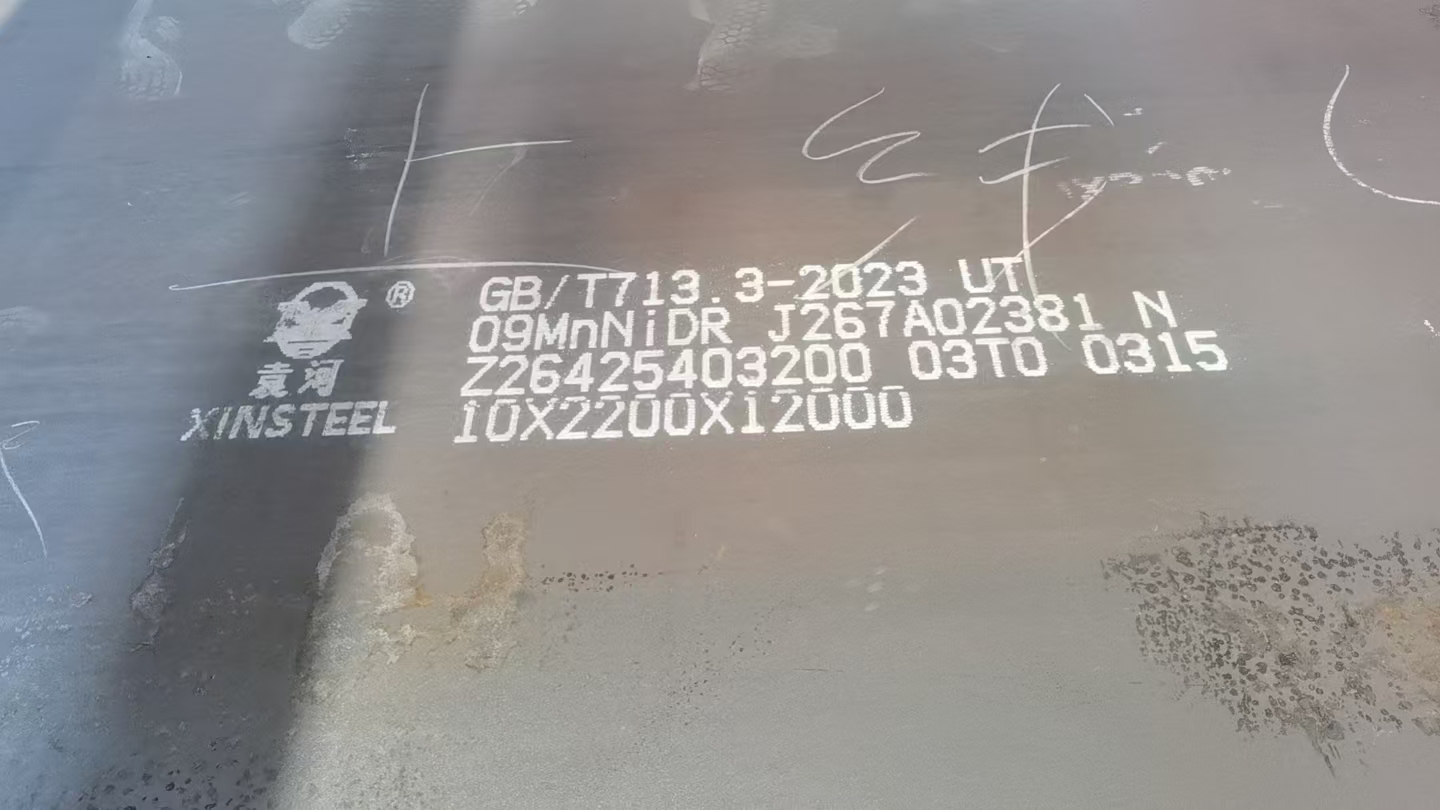
| 09MnNiDR | 6–120 | -70°C | Normalized (or N+T) |
| 08Ni3DR | 6–100 | -100°C | Normalized + tempered |
| 06Ni9DR | 5–50 | -165°C | Quenched + tempered |
Typical applications
Ordering notes
The critical clause is the minimum design temperature and the impact test temperature. 09MnNiDR is routinely impact-tested at -70°C; colder designs step up to 08Ni3DR or 06Ni9DR. Nickel-bearing plate is almost always forward-booked — plan four to six weeks ahead.
UT is equally serious: low-temperature vessel plate is normally tested plate by plate to Class I or II, and welded structures with through-thickness loads get Z15/Z25/Z35 added. We hold 09MnNiDR and 16MnDR in stock, 6–120 mm, cut to your profiles.
常见问答
Where is 09MnNiDR used?
09MnNiDR carries a standard minimum impact test temperature of -70°C and is widely used for ethylene cold boxes and cryogenic storage vessels. Below -70°C, designs move to 08Ni3DR (-100°C) or 06Ni9DR (-165°C).
Can 16MnDR replace Q345R?
No. They belong to different systems: 16MnDR is a low-temperature steel guaranteed for -40°C impact, while Q345R guarantees ambient impact only. Vessels below 0°C are specified to DR grades by the designer.
How to order UT and Z grades?
Specify plate-by-plate UT per GB/T2970 at the class the design requires (I or II); add Z15, Z25 or Z35 through-thickness properties for thick welded joints prone to lamellar tearing.
Further reading
A few related pieces worth a look: